12 Product
Pipe Riser Isolation
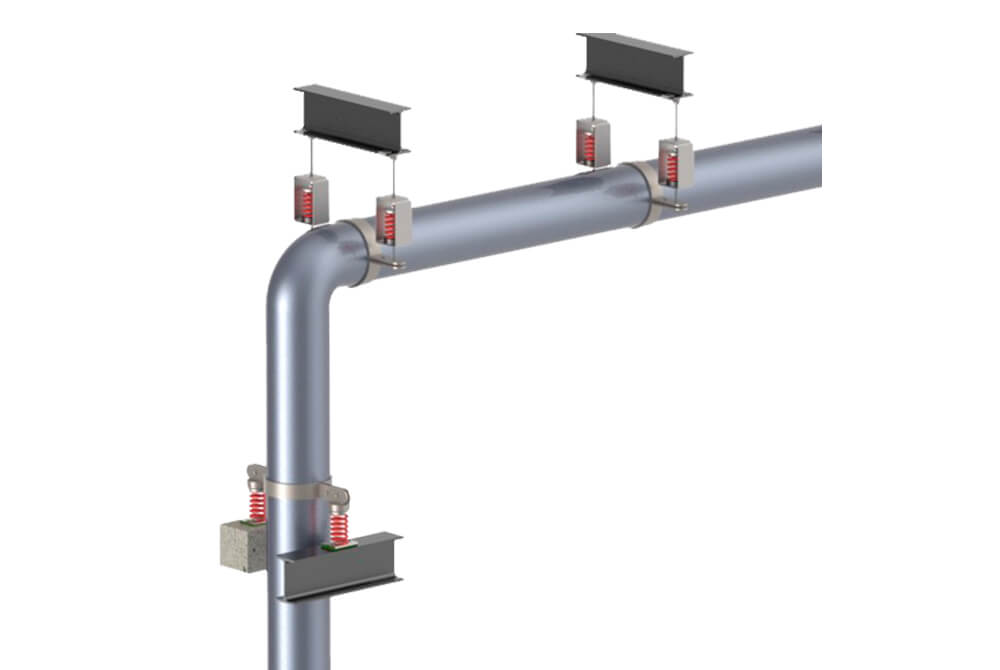
Vertical pipe risers in tall buildings are subject to a combination of forces that conventional brackets cannot adequately address — hydraulic pressure variations, thermal expansion and contraction, and the need to prevent structure-borne noise from travelling through the entire height of the building. AMC's pipe riser isolation system uses Sylomer® spring mounts along the pipework to handle all three simultaneously.
The Problem
- Tall building risers experience hydraulic forces from pressure changes as water is drawn from different levels simultaneously
- Thermal expansion and contraction cause the pipework to move vertically — fixed brackets crack walls and damage pipe joints over time
- Pumps and flow-induced vibration travel through rigid brackets into the building structure and radiate as noise across multiple floors
- Traditional expansion joints and horizontal expansion loops require significant additional space and are prone to failure
The Solution
- Sylomer® spring mounts are installed at calculated intervals along the riser — absorbing loads from hydraulic forces, thermal movement, and vibration simultaneously
- A fixed anchor point is placed at the midpoint of the riser's total height — distributing thermal expansion evenly upward and downward, halving the movement at each end
- The number, position, and type of supporting mounts are determined from the maximum loads and temperature extremes of each project
What Causes Hydraulic Forces
- Water pressure in a tall building riser varies as draws are made from different floors — creating pressure waves and surges
- Pump start/stop and valve closure generate water hammer — transient pressure spikes that can exceed static design loads
- Rigid fixing brackets transmit these forces directly into floor slabs and walls
How Spring Mounts Help
- Sylomer® spring mounts deflect under dynamic loading — absorbing energy rather than transferring it to the structure
- Mount stiffness is selected to provide the correct natural frequency for the expected hydraulic excitation range
- Effective for both steady-state pressure loading and transient water hammer events
Design Approach
- A single fixed anchor point is installed at the midpoint of the riser — the pipe can only expand or contract away from this point
- This halves the effective expansion length compared to anchoring at one end, reducing movement at each terminal by 50%
- Spring mounts above and below the anchor allow the pipe to slide freely during thermal cycling without building up reaction forces
- Eliminates the need for large expansion loops that require additional building structure and maintenance access
Temperature Extremes
- Mount selection accounts for both maximum operating temperature (hot water) and minimum ambient temperature during shutdown
- Sylomer® maintains consistent performance across the full temperature range experienced by the riser
How Acoustic Isolation Works
- Flow-induced turbulence and pump vibration travel along the pipe wall as structure-borne noise
- Each rigid bracket is a transmission path — in a tall building this means every floor receives the noise from every pump and valve in the system
- Sylomer® spring mounts at each support point interrupt the transmission path — the pipe vibrates, but the building structure does not
Benefits for Building Occupants
- Pump and flow noise eliminated from all floors served by the riser
- Particularly important in hotels, residential buildings, and healthcare facilities where night-time noise is a primary concern
- Single installation decision delivers both structural and acoustic performance — no need for separate acoustic treatment