19 Product
Akustik Tiltfix
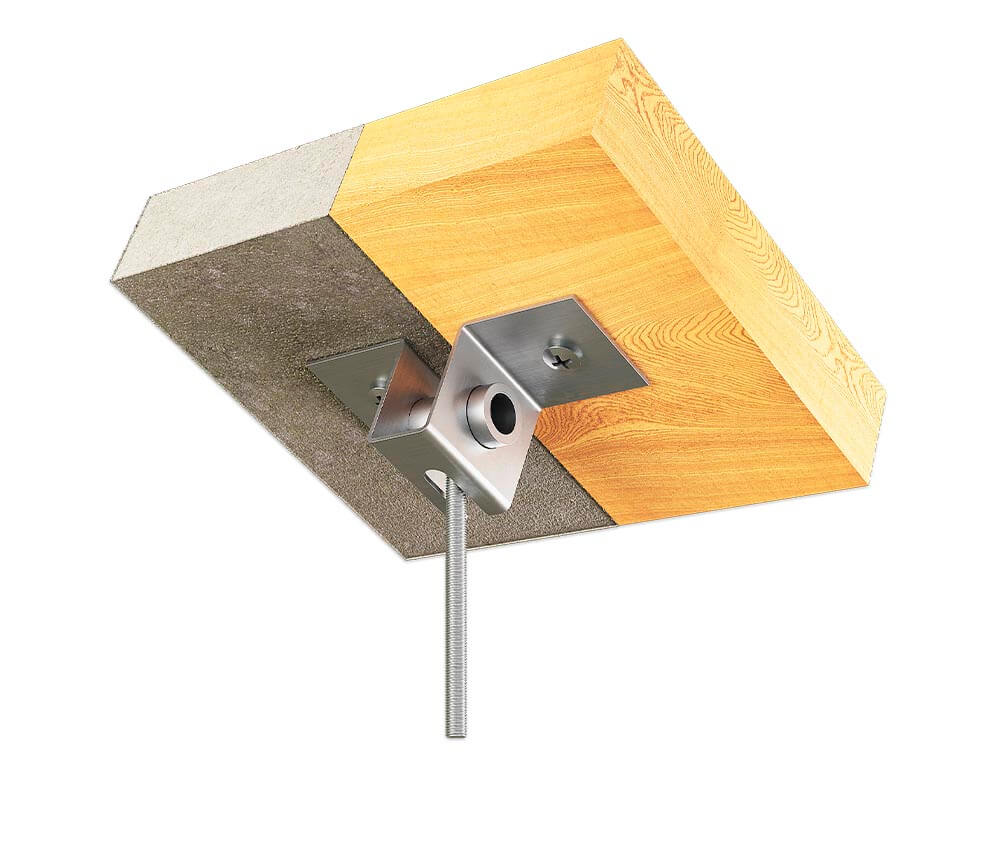
The Akustik Tiltfix is a fixation accessory for installing acoustic ceiling hangers on non-planar ceiling surfaces — sloped roofs, arched vaults, stepped soffits, and any structural ceiling that is not flat and horizontal. A double metallic edge provides two fixing points on the tilted surface, ensuring a secure, stable hanger connection regardless of ceiling pitch or curvature.
The Challenge
- Standard ceiling hanger fixing plates are designed for flat, horizontal surfaces — on a sloped or arched ceiling they make contact at a single edge only, creating a rocking base that loosens under load and vibration
- Shimming or packing behind a standard plate on a sloped surface introduces additional contact paths that can transmit vibration around the hanger's isolation element
- Arched and vaulted ceilings present a continuously varying pitch that makes a fixed-angle solution impractical — a self-accommodating design is required
How Tiltfix Works
- The Tiltfix replaces the standard flat fixing plate at the top of the hanger rod — it sits against the tilted ceiling surface and provides two distinct metallic contact edges rather than a flat face
- The two edges span the pitch of the ceiling — both edges make firm contact on a sloped surface regardless of angle, eliminating the single-edge rocking problem
- High tensile resistance allows it to carry the full hanger load without deformation across the range of ceiling angles encountered in practice
- Chrome anticorrosive treatment ensures long-term durability in both indoor and outdoor environments
Compatibility
- Designed for use with the full AMC Akustik ceiling hanger range — Akustik 1, Akustik 3, Akustik 4, Akustik GB, Grand Akustik 2, ST, SRS, and EP 700
- Product code: 23770 · 3D BIM model available
Where It Applies
- Suspended acoustic ceilings below pitched roof structures in houses, churches, and commercial buildings
- Mono-pitch industrial and warehouse ceilings where the structural soffit follows the roof slope
- Mezzanine underside fixings where the soffit follows a staircase or ramp gradient
Installation Notes
- The Tiltfix is fixed to the sloped surface first — both metallic edges bear against the soffit, providing a flat reference plane for the hanger rod to hang vertically
- The hanger rod hangs plumb regardless of ceiling pitch — the suspended ceiling grid below remains level
- No angle calculation or custom fabrication required — the double-edge design self-aligns to the surface
Where It Applies
- Historic and ecclesiastical buildings with barrel-vaulted or groin-vaulted stone or brick ceilings
- Contemporary curved concrete or steel soffit construction in performing arts venues, transport terminals, and civic buildings
- Domed and half-dome ceiling structures in hotels, reception spaces, and atria
Why Standard Fixings Fail Here
- On a curved surface, the local pitch at each hanger position is different — a standard flat plate would need to be individually shimmed at every fixing point
- Tiltfix adapts to the local surface angle at each position without any bespoke fabrication — the two metallic edges make contact on the curve regardless of local pitch
- Reduces installation time significantly on large arched ceiling projects with many hanger positions
Where It Applies
- Coffered concrete slabs where hangers must fix to the sloped faces of the coffer rather than the flat soffit
- Stepped ceiling structures in multi-level commercial interiors where the suspended ceiling must follow the changes in level
- Upstand beam and rib structures where the hanger fixing point is on an angled face rather than a horizontal surface
Performance Properties
- High tensile resistance — rated to carry full hanger loads at the angles encountered on stepped and coffered surfaces
- Chrome anticorrosive treatment — suitable for indoor and outdoor applications including car parks, covered walkways, and exposed concrete structures
- Compatible with BIM workflows — 3D model available for coordination with structural and architectural models